Notes: 1. The confusion of lesser languages - 2. Pain and death
|
Every time initiatory subjects were taken from the mystery Schools they were deformed because of the exoterical languages used to deal with those subjects; they replaced the words they couldn’t understand with figurative and fantastic ideas and hid their fundamental principles. In this way the vulgarization of the initiatory lexicon occurred.
This wasn’t a problem only for the Hierophants. The Masters of mysticism faced the same obstacle, added to the spiritual recklessness of their followers.
In any case, the popular credulousness and the ignorance of the followers left room for exuberant and fantastic interpretations; the excessive emotionality, therefore, re-veiled (veiled twice) the subtle meanings of the greatest teachings.
Even when the popular conscience wanted to get hold of the archetype-spiritual idea, it confused most of the ascetic realities with the fog of imagination. The metaphysic of the spiritual thought disappeared among intricate formulations with an expression far too human. |
In this way, oneiric vision and myths ended up by covering with fantastic fabrics the Idea of an archetype beyond this world, which was confused with old tribal memories. The latter became the rudiments of the first "lesser traditions". [1].
The formula of: merit and demerit, demerit is one of the many dialectic mistakes of those "traditions". It has caused the decadence of the karmic principle of loss and acquisition of conscientious qualities in the commercial contest of prize and punishment. This is not acceptable to those who consider the value of an individual conscience as a sum of abilities which can’t be acquired by clauses of remission or indulgence. Especially if we think that the quality of a conscience is given by the clearness of its substance and the purity of its vibration (the silent sound). Therefore it is quite daring to attribute its merits to the moral conditions originated by a profession of faith or another.
Furthermore, the spiritual conscience is not subjected to any physical sense. Since it doesn’t react to any physical emotion, it can’t wish for prizes or be afraid of punishments.
Yet, in certain circumstances, the superior conscience can be reached by a particular emotion. The superior Ego acknowledges "states of need" coming from its own material personification (the physical self) and it reacts to them.
Deep sensations of alarm and worry can lead the fragment of conscience identified with the physical nature into disharmony and unbalance. In order to react to this disharmony, it emits a deep invocation, appealing to its major simile, which is the conscience of Self or superior Ego. It is the reflection of the soul as much as the soul is the spiritual reflection of the monad, which is the inner God for the mystics. In actual fact the spiritual monad is the so called Son of God created in his likeness, not the obscure counterpart of his materialization (the physical-animal body).
A superior impulse of “help and support” replies to the invocation of the conscience. This support always goes towards the direction of the physical conscience, not the material personality [2]. Therefore it is not possible to gain any advantage from an evocation that has egoistic or utilitarian goals.
The help and support given by the superior conscience is often compared to human love. This is not entirely true, because the help and support of the superior conscience are not the result of an emotional answer but rather a reaction of balance and fairness that can be compared to the "fullness" that helps filling "emptiness".
It is something like the push that every natural entity needs to re-establish the balance after a momentary deformation. Here we find the correlation between similes.
The formula «Similes cum similibus», means the attraction that every "major simile" exerts on a "minor simile".
This occurs among similes such as the physical conscience and the super-consciousness, with some karmic aspects that we will try and define.
The ‘destiny’ of peoples is determined by the impressions that their thoughts, decisions and deeds leave on the same ‘electrical’ substance (reflecting ether) called planetary conscience (Anima mundi); many easterners call it “Master of the Karma” and many westerners have represented it in the biblical God called “Yahweh”.
The Karma of a people, though, is not a Master or a God, but only the effect of decisions made by a few, which have the power to mark the "Destiny" of many people. Every choice, then, determines a direction that leads somewhere, leaving aside all the other directions which are then ignored.
Every decision made can reveal itself good or bad for oneself or the others. In any case they all produce "concrete effects"; if they turn out to be in opposition with the rules of balance regarding the physical, emotional or mental plane, they will have to be adjusted by the individual or group conscience (collective or individual unconscious) as if they were the impurity of any other "organism". In other words, every physical, emotional or mental "decompensation" will have to be absorbed, digested and expelled.
There’s no point in repeating that the superior planes of conscience (the super-conscious), even individual conscience, are free from any kind of "turmoil" because the latter belongs to the physical-emotional conscience (the lower self, personality).
The karmic conditions of the single individual are given by the universal causes that tie every people to a unique plot; furthermore they are affected by the ‘results’ of the thoughts, deeds and decisions made singularly that are impressed in the personal conscience.
The personal conscience, on the contrary of what we think, doesn’t find its collocation inside the human being; it ‘surrounds’ him through the phenomenon called "aura".
The conscience is reflected inside the being through feelings and conscience, but as a whole phenomenon it stays outside the material element to which it is linked through the mind.
The aura is an energetic phenomenon comparable to a radiant field that, in the stage of lowest development, appears in the form of a confusedly colored area, dense and reflective, that surrounds the material body and its magnetic components (electric aura).
Both the minor field (individual aura) and the major field (planetary aura) are parts of a unique intelligent system that, by induction, is linked to even bigger cosmic aspects.
This is the: «similes cum similibus»; the tiny individual tends to re-identify with the huge macrocosmic one when the latter tries to get its little fragment back.
The similes often undergo extremely different conditions; their constant search for each other and the unconscious "desire" for each other for a long time, without knowing why, is a wonderful example of life that the creation gives us. It is an expression of will where we can see a supreme act of love of the human being, which doesn’t know the selfishness of the pos-session but only the search for the other part of oneself.
For this reason when we try and understand the Karma, we shouldn’t only consider the small personal conductions, but we should also discover the main relations between self, humankind and the higher degrees of the cosmic conscience we are part of.
The word "Karma" is used to express the principle that transmits the effect of return, the reaction or the answer to the motion generated by a cause, independently from its nature, condition, plane or level where it belongs.
Every emotion, passion, thought, decision and deed is a ‘movement’ and as such it produces reactions, whose effects stay until we exhaust the dynamic push that animates them..
We can say that the push is the Karma, whilst the tone, intensity and duration of every effect (both physical and mental) are affected by the strength of the cause that generated it. Every kind of appearance, from the physical to the spiritual one, is characterized by the energetic will (impulse) that originated it (cause).
In the human being the qualities and hues that "color" his emotions are determined by intentions. They are originated by the emotional will, and reflect on every impulse. We can find in impulsivity the resolution of many karmic knots.
Man has always taken himself as a model to measure the world and the universe. He has ended up by "building" a world too similar to himself. He has preferred to reduce it to the measure of his own sensations, rather than trying to find more sensible answers in abstract. On the contrary, the initiatory science has always wanted to penetrate its phenomenal surface and reach its natural sense. With the help of comparison and analogy, the initiatory science reached the similitude that let it progress in the knowledge of the being, not only as an ‘animal creature’ but also as a cosmic and universal entity.
In order to formulate this rule it was necessary to assume that the humankind is part of a vital environment much wider than what we can see through the physical eye. It was necessary to open to the idea of the relevance of the vital relations between every level of life.
This idea was the fulcrum, at least an ideal one, to link natural sections apparently far away and different from each other, such as spirit and body.
The principle of these relations is vitality.
Vitality (vital energy), supports every aspect of life but it must be supported on its turn as well.
The vital energy ‘animates’ every living form and phenomenon. Its function is to support and feed. On the other hand, it must be supported and fed by the spirit as well..
In order to study the subject we must acknowledge some delicate combinations regarding mechanisms of realities parallel to the physical one. Therefore even if we talk about the ‘same energy’ we must understand that it changes when it goes from a substance to another of different matter. For every living substance, then, from the heaviest to the most subtle, the vital energy is the common denominator to understand their essence. The reason is that precisely this common denominator determines the ‘energetic communion’ that blends different substances in every level of the universe. The motto: “up as is down” reflects the similitude between different aspects. The latter are the reflection of the same universal matrix, where everything lives and is supported by energetic transmission, namely by transfer. The semantic key of "similitude" is therefore the word osmosis.
It appears more and more evident that for many aspects of vitality and support, the Karma should be compared to a sophisticated immunization system; a higher form of metabolism, necessary to avoid gross intoxications to subtle entities such as soul and spirit.
It is a mechanism that uses the subjective conscience of the temporal self; it metabolizes and dissolves the signs left by the inconsistencies of a personality still too affected by the sensations it can’t manage properly.
It is a lower self, then, because its moral conditionings are subjected to the impulses of the physical reason.
|
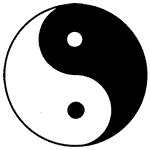
To approach correctly the meanings of merit and demerit, then, we should compare them to the symbols of Yin and Yang, rather that using the allegory of good and evil. It is an irreproachable formula, used to express the dualism of a positive-negative polarity of energy (physical, emotional and mental); it encourages every aspect, form and appearance of the phenomenal world where every living entity, spiritual as well, is immersed. |
The Yin and Yang symbol states an indisputable truth: the opposites don’t ignore each other but rather complement each other. A part of one is always present in the other as well. If there is a conflict between the two parts it must not be attributed to reality, but to the state of confusion in the recognition between different positions. This should make us reflect on the masculine-feminine binomial.
From this point of view good and evil should be considered as states of conscience that concur to its balance or affect their value by producing moments of imbalance.
Evil is the deformation by excess or default of a reality otherwise balanced.
Good is the feeling that states positivism and balance, following a cosmic rule that corresponds to "harmony"; it implies the principles of justice, economy and fair distribution.
From the cosmic balance called «Harmonics» originates the inborn sense of justice that from the macrocosm (divine hyperuranium) reflects into the individual microcosm; it allows the conscience of the physical man to participate the universe. If we turn this reflection upside down it immediately becomes substance of selfishness, separation and isolation. It is a mood of the heart (heart and not soul) that "generates" detachment and spiritual negation; it can only generate injustice, for oneself and the others, which will then be considered distant, different and therefore antagonist. 
__________
Notes
1. The confusion of lesser languages
«To restore» the originality of initiatory themes, extracting them from the "doctrinal confusion" and the "philosophical conflicts" of the lesser traditions, means to "travel backwards" toward the world of causes, ignoring the world of effects. This is the journey the researcher must complete.
This is the journey of the man who doesn’t give up to the exoterical re-veiling (to re-veil = to veil twice), but he rather sets off in the search of the ideal point where reality and imagination start blending and dimming the ideas where principles are reflected.
In order to elevate one’s center of conscience and leave the imaginary, it is necessary to walk backward towards the line of intellectual disorder (chaos). We must destroy the exterior forms of concepts and penetrate the meanings of literal and exoterical forms; we will then reach the soul of the word.
The occult meaning of the word will reveal its "power" that every Initiate is instructed to recognize and use. It is a sound that has the strength to "evocate" (generate) mental images (forms), feelings and emotions or to destroy them, dispersing them and freeing the energies that ‘animated’ them making them live substance.
Semantic analysis, analogy, correlation and intuitiveness light up the path of the traveler. These are instruments able to reconstruct every meaning, according to ideal proportions and geometries to represent the original thought.
The Science of Harmonics (see H. Kaiser and the Pythagorean school) includes also mental representations. It shows how to create through mathematical principles a process of harmonization between form, concepts and the prime idea (see synthesis: mental operation that organizes in a unique perspective elements that would be otherwise single and manifold) which was its matrix.
By harmonizing the meaning of the expressive form we can go from the figurative formulation of language (exoterical expression) to the synthesis of the idea (esoterical expression) which the different idioms try and transmit. The instrument that can represent correctly an idea, which is synthetic and immediate, is not a language but a symbol.
The inner element of the symbol and not its exterior form protects the synthesis of the idea; it preserves its "whole" meaning. The figurative literal form, by interpreting the synthetic meaning of the idea, deforms its sense and dilates excessively its representation. Only a process able to "reverse" the process of dilation of the literal form will be able to nullify the obvious deformations produced by the originality of the idea, especially in the cases where the meanings of the idea itself have been shadowed by the clear inability of its interpreters. (back to the main article)
2. Pain and death
Pain and suffering are the only physical needs that can express a "mental" message in a synthetic form, namely without words, which can reach the superior Ego and evocate a need for "help". Pain and suffering are therefore the only synthetic language that the mind can express. They are the only expression recognized by the superior Ego; otherwise the latter is not able to perceive any formal term of the common language, which is on the other hand coded through a scale of impulses that it doesn’t feel or recognizes.
The evocation produced by a quiet status of need is like the instinct to survive; it is unconsciously directed to the unknown conscious and superior identity which the last appeal is directed to.
Evocating a status of need is not comparable to a simple desire to survive, or to react to fear for an unknown danger. The latter are all sensations that can cause psychic alarm and tension in the lower personality.
The material mind obviously fears physical death. The hope to survive in a promised heaven doesn’t persuade it to abandon easily the hell of the matter.
The advanced Initiate, on the other hand, compares himself to a micro-unity, which is part of a more complex central Unit. He ends up by giving little importance to the temporal passage of his person. His rule is to have a small consideration of himself as a physical unit; he consider the latter still too detached from his spiritual (nuclear) identity, which is the true reflection of the higher Unit.
By restoring in himself the "sense of belonging" to the central Unit (Atom – God), the conscience of the advanced initiate transmits to his own physical mind the sensation of immortality, so that it can shout: "I know immortality!"
This inner acknowledgement illuminates the mind and disperses the fear to overcome the "physical threshold" of life, which carries on. (
back to the main article)


