Comments on birth, illness, recovery, death and re-birth of the being
The Karmic phenomena of individual existence
Introduction
In order to reach a holistic vision of the initiatory thought, the Western researcher can’t but study in depth the fundaments of the Eastern esoterical tradition as well. Only by prying into the other half of the initiatory sky, the adept will be able to reassemble the two halves of the thought that inspired the higher Mysteries.
In the work we present we’ll deal with the Eastern idea of physical existence and its phenomena and connections. We’ll follow the principles of a Western mental vision which is impersonal and lacks prejudices, so that it can guarantee a certain vision of the subject involved in the matter.
The origin of karmic mechanisms
It is not easy to comment in suitable form ideas so far away from the Western cultural environment as those in the Eastern esoterical vision.
In order to define the cyclicity of physical existence, that is the space where it moves, we’ll take the rhythm of the natural kingdom as an example; here life expresses the form of its existence in cycles called seasons.
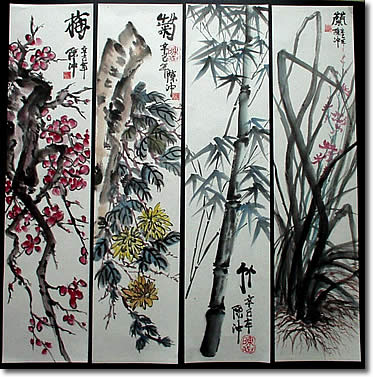
Spring, Summer and Fall are the cycles where the forms elaborated during the Winter express. The latter, where apparent life retreats, hides the turmoil of metamorphosis and renewal. Like any other natural form, the physical aspect of man undergoes cycles. The main ones are connected to birth and childhood, followed by youth and adulthood, old age and death.
|
|
Just like in winter, the soul as well needs a period to retreat from the physical aspect and to allow the conditions of its existence to regenerate; it needs the time for new conditions to be promoted so that the conscience can go back to new courses of learning.
The soul follows small cycles in order to express itself and they are linked to bigger cycles. It is a sinusoidal motion of space-time waves with 250,000 year intervals; in the Mediterranean region they were called "Eons" [1].
The Eras (eastern name) or Ages (western name) where human evolution was located are four. The first one is the Golden Age, followed by the Silver Age, then the Bronze Age and finally the Iron Age, which, according to this principle, is the present era: the Vulgar Era or Kali Yuga.
When the last Era ends the great cycle starts again, creating a new cycle of regeneration and following the thread of life that leads, from an existence to another, to the accomplishment of the Divine Plan [2].
By virtue of the "common fate", the smaller (25,000 and 2,500 years) and the individual cycles follow the same rhythm. Like in the winter, every last cycle is followed by the regenerating catharsis of the physical attributes of the soul; this will lead the material essence of the being (man and woman) to express more and more refined attributes.
The mechanism that controls limits, measures, qualities and conditions, in which physical phenomena evolve is called the Law of Cause and Effect.
This rule is so called because in each natural plane, from the most subtle metaphysical to the densest physical one, it is generated by a cause and nothing exists without a reason.
Every cause produces its result, like every effect expresses through its typical physical phenomena. Phenomena turn into activities and deeds; concauses originate from these and aspects from the latter; new effects will then be created and so on.
In actual fact, this Law is nothing but the thread of life that is transmitted; around it there is the aggregation of the causes that define the sequences of physical, phenomenal and formal representations.
The Law of Cause and Effect is, so to speak, a guiding thread, the judge and instructor of the earthly experience. It is the thread that leads every telluric existence and determines the requirements for every status or condition. It fixes the environmental characteristics, the physical and mental aspects, illnesses, recoveries, requirements and attributes of the individual death.
In the terms of cause and effect we recognize the element that conditions and determines the kind of expression which the physical component in manifestation undergoes. This element is Karma. This is a Sanskrit word often interpreted in the sense of fatal casualty, which makes its original philosophical meaning quite vague. Therefore the karmic principle is sometimes identified with the idea of casual fatality, relative and above the tangible reality.
Fatality, though, is an inheritance of totemic culture. The principle of fatality is commonly linked to the presence of an incomprehensible arbitration at the basis of existence. It would be an obscure and casual arbitration that can give away fortunes or misfortunes, worries or privileges, punishments or absolutions. Finally, it is a segregationist formula that seems to be a source of disparity and prejudice.
The karma is not presented as an arbiter, but rather as an "instrument" that uniforms individual gaps, excesses or deficiencies; it re-distributes their effects through a systematic allocation in time and events. In the karmic vision, therefore, the idea of fatality is absent; the only elements considered are the effects of causes generated by the person that will then be subjected to its debits and credits.
From this point of view we can think of the karma as an instrument of "measure". It is a means of fair distribution; it helps us assign to future moments the result (compensation and decompensation) of choices and deeds that are wished for today but will be put into practice tomorrow (see the difference between "free choice" and Free Will). 
_________
Notes
1. Eon – from the Greek aidn-dnos, eon is a measure of time that Aristotle translated into: to be always. Through the vulgar habit of converting every super-sensitive idea into human form, the time units, close to infinite for the physical reason, became Eternal beings, directly created by God, they were the intermediaries between the Creator and the phenomena of the sensitive world. The use of this anthropomorphic representation for time unit, close to infinite for the physical reason, was kept by the new-platonic followers (St. Augustine) that strengthened its ‘spiritual’ meanings up to the Gnostics. (back to the main article)
2. The Divine Plan, in the phenomenal aspect is the will of God to pursue a "proposition of self-conscience"; through this he can reflect into the densest planes of the matter and illuminate of Himself his Creation. With a metaphor, this teaching says that the Creation is the cover of God, his Body. The proposition to reflect himself in every single "atom" (spiritual spirilla) shows the intention to make the Body totally aware of its Creator. When the smallest part of the creation will understand its Creator’s conscience, then God-Creator as well will realize the full conscience of every part of Self. (back to the main article)